Natural wood suspended ceilings have undergone significant technical evolution, transitioning from primarily decorative elements to multifunctional construction solutions that simultaneously address aesthetic, acoustic, technical, and maintenance requirements. In contemporary architecture, these systems create spaces where the warmth of wood is complemented by advanced technical performance.
The implementation of natural wood ceilings offers multiple benefits, from creating visually welcoming spaces to improving acoustic performance and efficiently integrating technical installations. Advances in manufacturing have overcome traditional limitations of wood as a material for suspended ceilings, opening new design possibilities.
Types and Technical Configurations
Continuous Panels
Continuous panels create homogeneous surfaces that can incorporate integrated access hatches for technical installations. Using products like NATURPANEL-W, these solutions generate uniform horizontal planes that enhance the sense of spatial continuity.
Common configurations include:
- Standardized panel dimensions (typically 2440×1220 mm)
- Thicknesses ranging from 8-12 mm, depending on requirements
- Systems for fastening to metal framework or wooden battens
- Perimeter joints of 6-8 mm to accommodate movement
Plank Systems
Plank ceilings feature linear elements with gaps between them, creating visual rhythm while allowing integration of installations between components. This configuration also facilitates ventilation and maintenance of the plenum above.
Available technical options include:
- Plank widths between 100-300 mm
- Gaps between planks ranging from 15-50 mm
- Installation parallel or perpendicular to main facades
- Option to integrate linear lighting between planks
Accessible Systems
For spaces requiring frequent access to installations, accessible systems enable modular, removable ceilings. Using visible or concealed channels, these systems combine practical functionality with integrated aesthetics.

Technical Performance and Features
Acoustic Performance
Wooden suspended ceilings significantly contribute to acoustic conditioning through:
- Sound absorption: Absorption coefficients (αw) ranging from 0.15-0.30 for solid panels and up to 0.75 for perforated panels with absorbent backing
- Controlled sound reflectance: Distributing sound more evenly than highly reflective materials
- Mixed configurations: Combining absorbent and reflective zones based on acoustic needs
This performance is particularly relevant in spaces like the St. Mary’s Calne School Library project, where natural wood ceilings create acoustically comfortable environments.
Performance combating fire
Suspended ceilings must meet specific fire protection requirements based on their location and building use. Parklex Prodema’s natural wood ceilings offer solutions that ensure safety without compromising aesthetics. Specifically, they have the following specifications:
- Fire classification D-s1,d0 for NATURPANEL-W S (standard) and C-s1,d0 for NATURHARDPANEL-W S (standard)
- Fire classification B-s2,d0 for NATURPANEL-W F (fire-retardant) and B-s1,d0 for NATURHARDPANEL-W F (fire-retardant).
- Certified systems compliant with international regulations
Durability and Dimensional Stability
Dimensional stability is critical for suspended ceilings, where excessive movement can compromise both aesthetics and safety. High-performance natural wood panels offer:
- Dimensional variations below 0.3% longitudinally and 0.6% transversally
- Resistance to fluctuations in environmental humidity
- Long-term maintenance of mechanical properties
Installation Systems and Construction Considerations
Fastening to Metal Channels
The most common system for suspended ceilings uses metal channels suspended with threaded rods or specific hangers. Key considerations for proper installation include:
- Channel spacing: 600 mm for 8-10 mm panels and 800 mm for 12 mm panels
- Minimum perimeter joints of 6-8 mm
- Fastening points 20-40 mm from panel edges
Special Suspension Systems
For projects with specific requirements, solutions include:
- Anti-vibration systems: Incorporating elastic elements to acoustically isolate the ceiling
- Seismic-resistant fastenings: Designed to withstand movement in earthquake-prone areas
- Concealed channels: Allowing continuous surfaces without visible fastenings
Integration with Installations
Coordination between the suspended ceiling and the building’s technical systems is essential. Wooden ceilings allow:
- Integration of recessed, surface-mounted, or suspended lighting
- Incorporation of HVAC diffusers
- Installation of detectors, sprinklers, and other safety elements
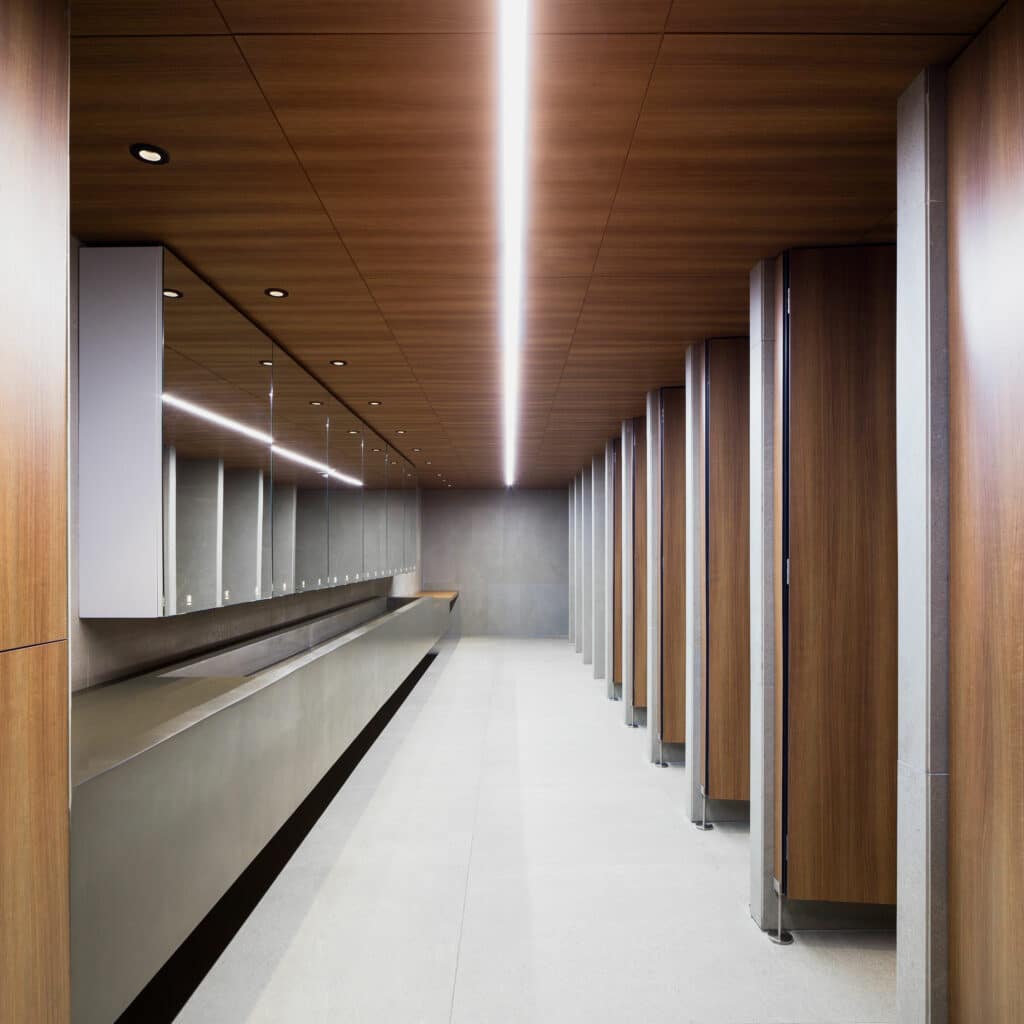
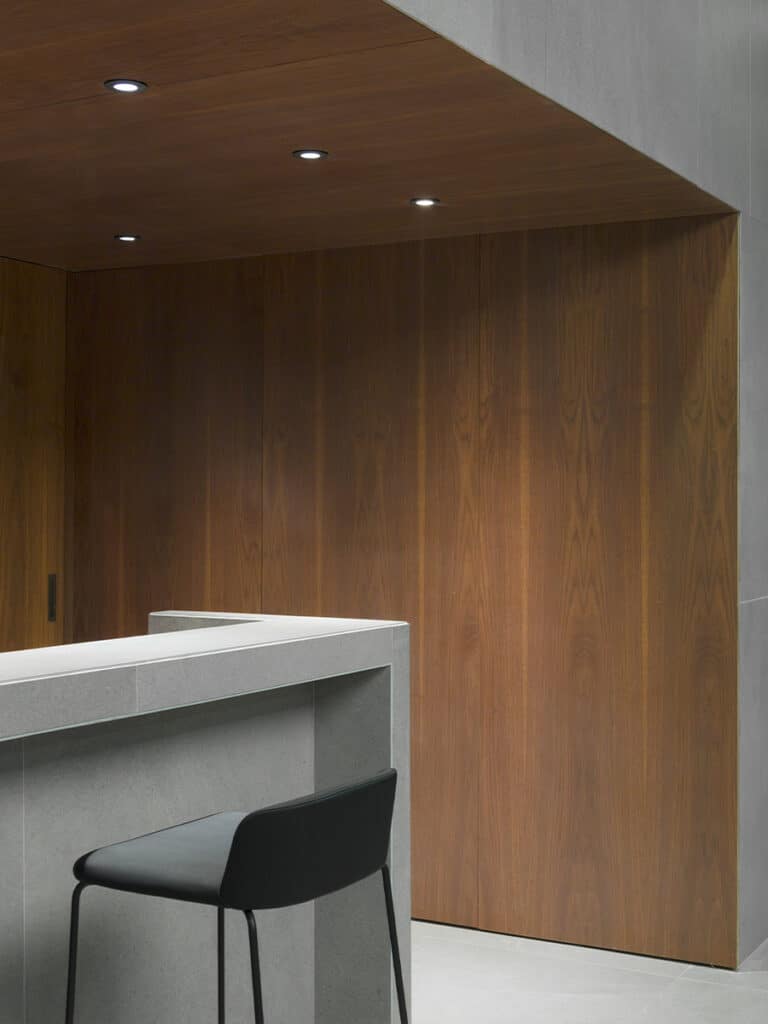
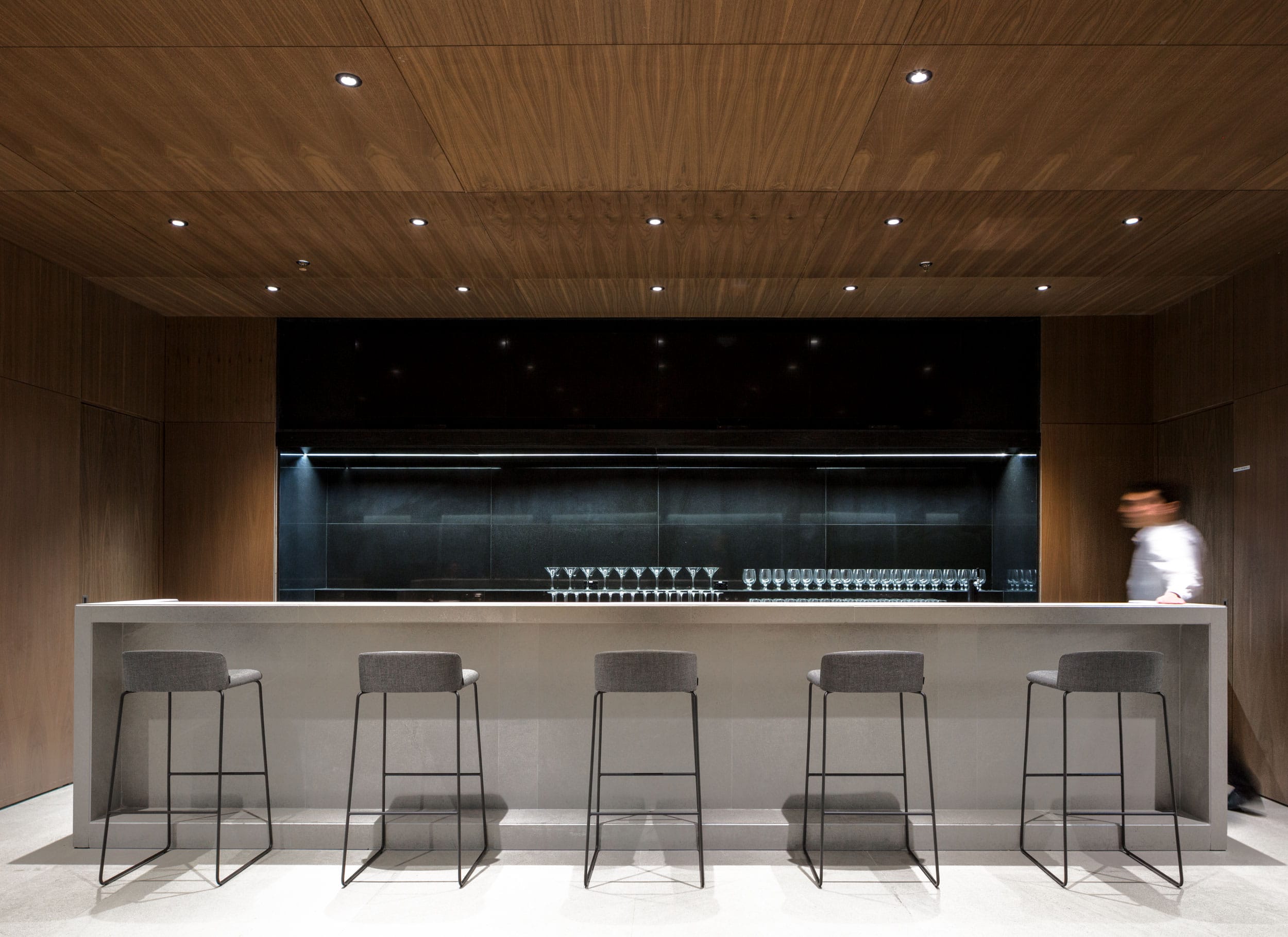
Avianca Lounges, Francesc Rifé Studio
Applications and Reference Projects
The versatility of natural wood suspended ceilings is evident in their use across various building types:
Cultural Centers and Auditoriums
In cultural spaces, wooden ceilings combine acoustic performance with aesthetic warmth. The faceted, acoustic wooden suspended ceiling at St. Mary’s Calne School exemplifies how these elements enhance the sensory experience of a space.
Corporate Spaces
In modern office environments, natural wood suspended ceilings add warmth, improving well-being and supporting focus and productivity. The Avianca Lounges project, designed by Francesc Rifé Studio, showcases their integration in high-quality corporate spaces.
Representative Areas in Public Buildings
Lobbies, reception areas, and transitional spaces particularly benefit from wooden suspended ceilings, creating memorable first impressions while meeting stringent technical requirements. The Moody Center at the University of Texas illustrates this through curved ceilings that generate dynamic spatial experiences.
Need specific technical advice for your project? Contact our team with no obligation to address technical questions, analyze specific requirements, or develop customized solutions.