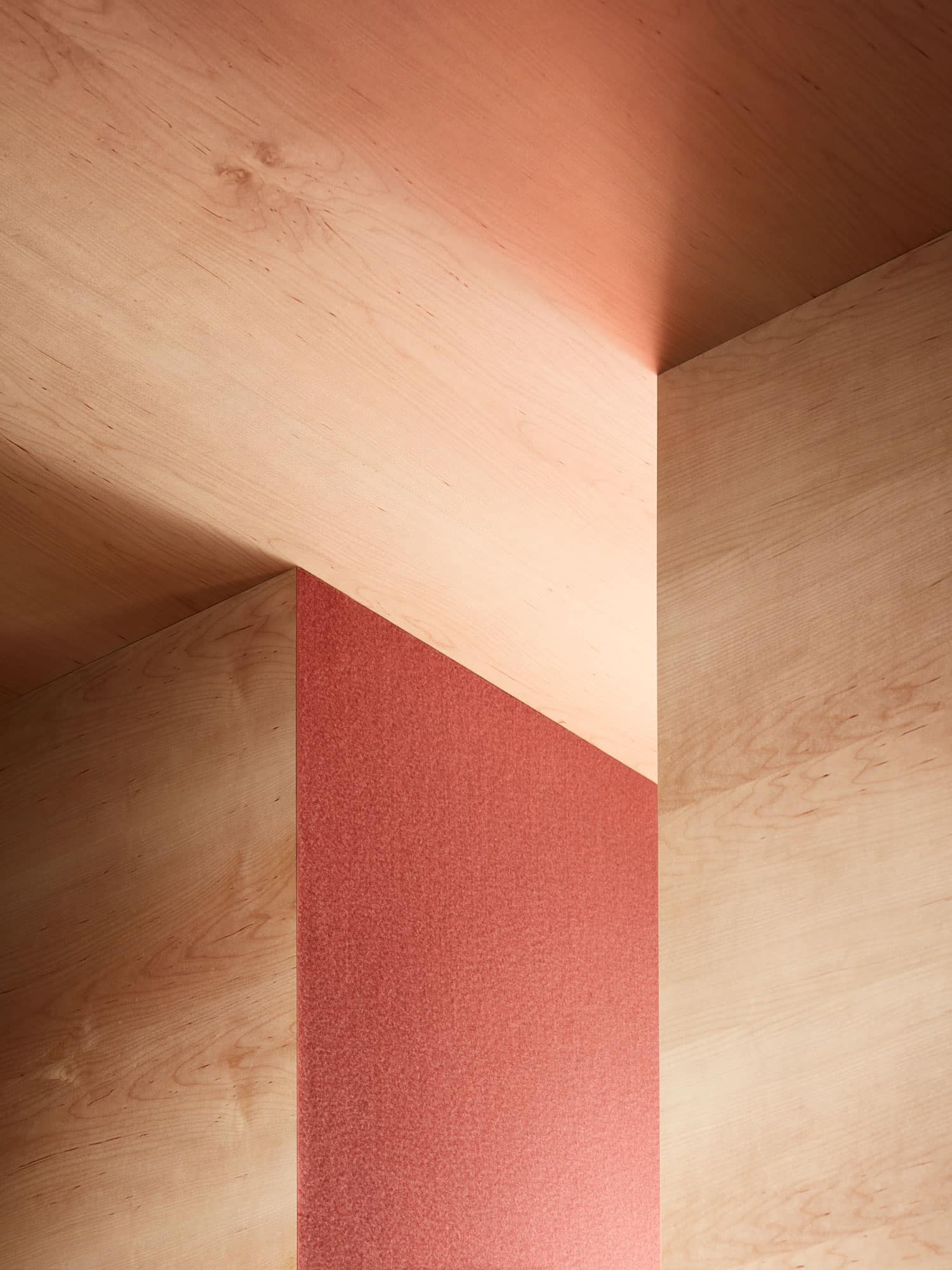
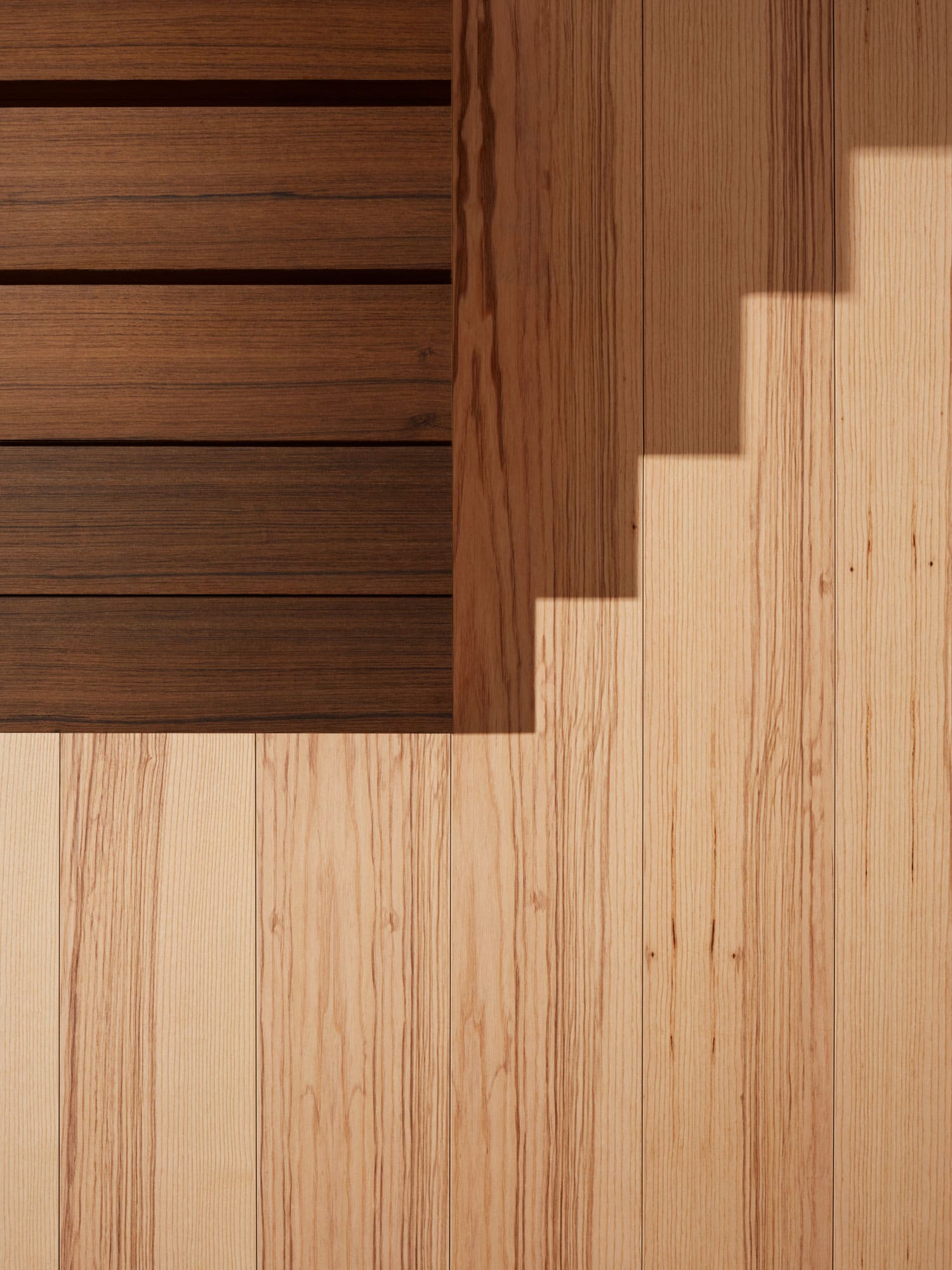
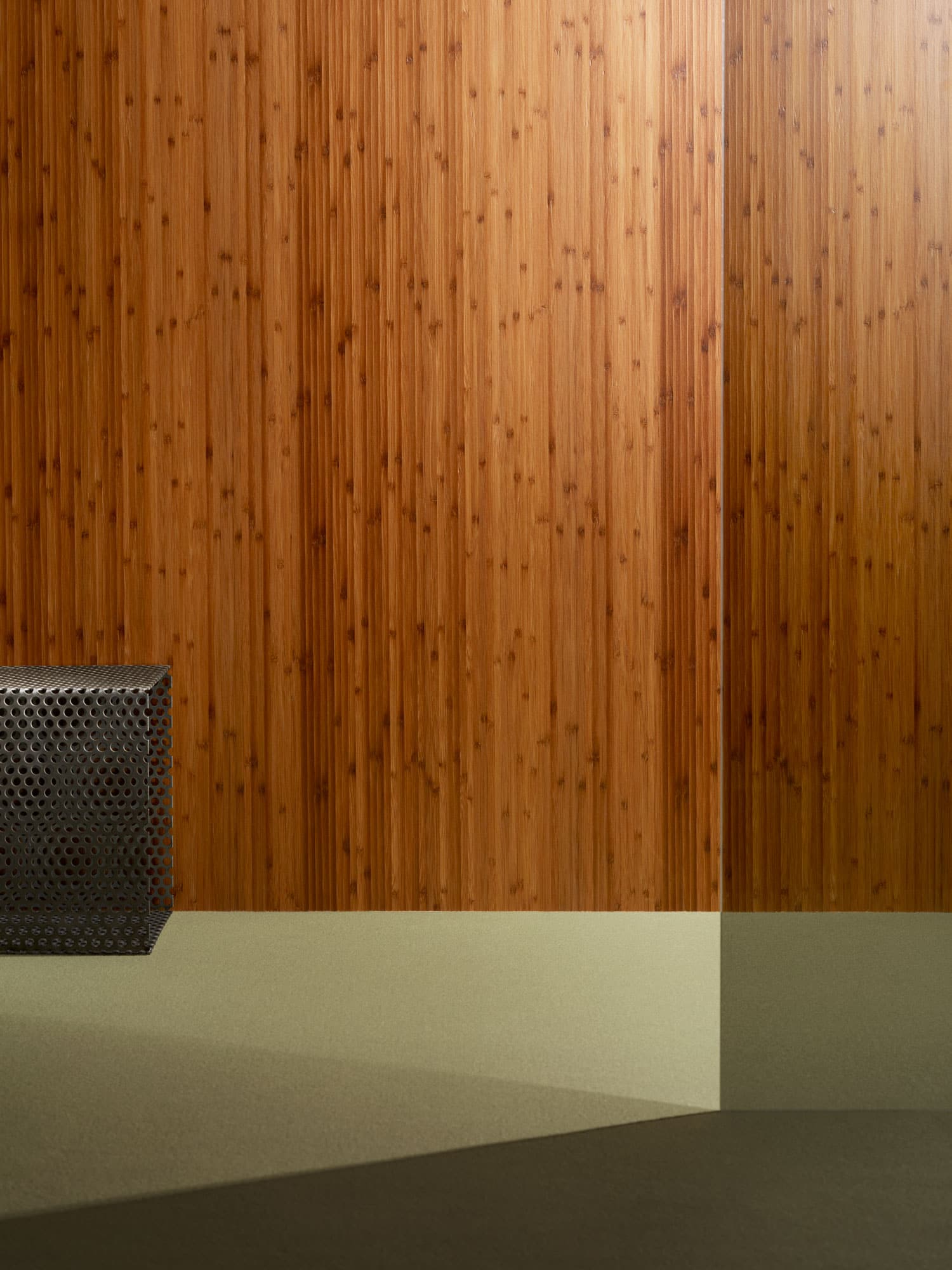
Fire-retardant natural wood paneling represents the convergence of two seemingly contradictory requirements: the aesthetic warmth of wood and the fire safety demanded by contemporary regulations. This balance, historically challenging to achieve, is now possible thanks to technological advancements that have transformed the fire reaction properties of wood without compromising its natural expressiveness.
Incorporating wood paneling in interior spaces must comply with increasingly stringent safety regulations, particularly in public buildings, evacuation routes, and high-occupancy establishments. While this traditionally limited the use of combustible materials like wood, advanced solutions now allow the sensory and biophilic benefits of natural wood to be enjoyed without compromising safety.
Technology Behind Fire-Retardant Natural Wood Panels
Composition and Structure
Parklex Prodema’s fire-retardant natural wood panels stand out from conventional ones by incorporating a core reinforced with fiberglass impregnated with synthetic resins and mineral fillers. This multilayer structure maintains natural wood on the visible surface while radically altering the material’s fire behavior.
The typical cross-section of these panels includes:
- Outer layer of natural wood or wood-textured finish
- Specific protective coating
- Fire-retardant core of fiberglass with resins and mineral fillers
- Balancing back layer
This configuration creates a hybrid material that combines the visual appearance of wood with superior technical performance in fire situations.
Fire Protection Mechanisms
Fire-retardant natural wood panels operate through several simultaneous mechanisms to enhance their fire performance:
- Ignition Delay: Specific treatments increase the temperature required to initiate combustion.
- Flame Spread Reduction: The panel’s structure limits the lateral spread of fire.
- Smoke Emission Minimization: Core components reduce the production of toxic gases.
- Structural Integrity Maintenance: The reinforced composition prevents premature collapse under fire exposure.
Classifications and Applicable Regulations
European Fire Reaction Classification
The EN 13501-1 standard provides the framework for classifying materials based on their fire behavior. Fire-retardant natural wood panels can achieve classifications such as:
- B-s1,d0: For panels like GRCLAD-W, indicating very limited fire contribution (B), minimal smoke production (s1), and no flaming droplets (d0).
- A2-s1,d0: For solutions like GRCLAD-B, considered nearly incombustible (A2), with the same favorable smoke and droplet characteristics.
These classifications allow their use in areas with high safety requirements, such as evacuation routes, public building common areas, and high-rise facades.
Country- and Application-Specific Regulations
In addition to the European classification, specific requirements vary by jurisdiction:
- CTE DB-SI (Spain): Specifies requirements for paneling in different building zones
- Document B (United Kingdom): Regulates material use based on building height and purpose
- NFPA 101 (United States): Defines requirements for evacuation routes and public spaces
For specific applications, such as healthcare or educational facilities, additional requirements may apply regarding the emission of toxic substances in case of fire.
Priority Architectural Applications
Evacuation Routes and Circulation Spaces
Evacuation routes require materials that maintain safe conditions for occupants’ egress during a fire. Fire-retardant wood panels allow these spaces to be designed with the warmth of wood without compromising safety, particularly in:
- Hallways and corridors in public buildings
- Lobbies and reception areas
- Protected staircases and independent lobbies
Auditoriums and High-Occupancy Spaces
In spaces with large gatherings, fire safety is a priority. Fire-retardant panels enable the creation of:
- Finishes for performance spaces
- Paneling in spectator areas
Specialized Sectors: Healthcare and Hospitality
Sectors with specific safety requirements particularly benefit from these solutions:
- Healthcare Facilities: Where paneling must combine safety, hygiene, and well-being.
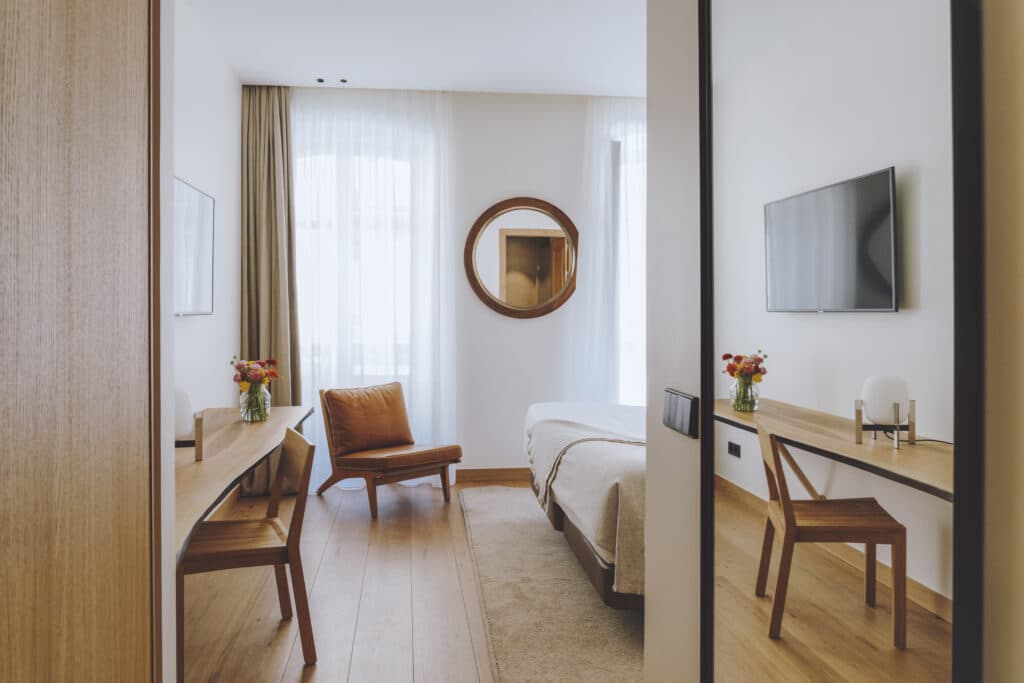
- Hospitality Establishments: Seeking warmth without compromising guest safety.
Technical Considerations for Specification and Installation
Compatibility with Construction Systems
Specifying fire-retardant panels requires consideration of their integration into the overall construction system:
- Subframe: Must be compatible with the panel’s fire reaction classification
- Insulation: Selection of materials that do not compromise overall performance
- Joints and Seals: Specific treatment to maintain compartmentalization
Specific Installation Details
Proper installation is critical to ensure fire performance:
- Channel Spacing: Typically 600 mm for panels 8-10 mm thick
- Fastenings: Metal with adequate fire resistance
- Treatment of Junctions: With other materials or construction elements
Maintenance and Durability of Fire-Retardant Treatment
Parklex Prodema’s GRCLAD-W and GRCLAD-B panels maintain their fire-retardant properties throughout their lifespan without requiring periodic treatments. Unlike traditional surface treatments, the protection is integral to the panel’s structure.
Maintenance is limited to regular cleaning with warm water and mild detergents, without the need for periodic varnish or flame-retardant applications.
Sustainability and Environmental Certifications
Sustainability concerns must not be compromised when specifying fire-retardant solutions. Parklex Prodema’s fire-retardant natural wood panels maintain significant environmental credentials:
- Forest Certification: Ensuring wood comes from sustainably managed forests (PEFC/FSC)
- Life Cycle Analysis: Assessing environmental impact from extraction to end of life
- Low VOC Emissions: Contributing to indoor air quality
These characteristics allow fire-retardant panels to contribute to certifications like LEED, BREEAM, or WELL, combining safety and sustainability.
Aesthetic Integration with Other Coverings
A key aspect for architects is maintaining aesthetic coherence throughout a project, even when different areas require varying levels of fire protection. Manufacturers like Parklex Prodema facilitate this integration by offering the same finishes across different technical substrates:
- Standard panels for areas without specific fire requirements
- Fire-retardant panels for areas with strict regulatory demands
- Intermediate solutions for specific requirements
This visual consistency allows for the design of spaces where safety does not compromise the architectural vision, enabling seamless transitions between different building zones.
Need specific technical advice for your project? Contact our team with no obligation to address technical questions, analyze specific requirements, or develop customized solutions.