In recent years, the focus of sustainability in architecture has moved beyond energy use during the operational phase to strongly incorporate the environmental footprint of materials. Today, it is difficult to discuss sustainable construction seriously without addressing embodied carbon, resource consumption, and the pressure on supply chains that remain energy-intensive. In this context, the use of recycled-content materials has become a real lever to reduce impacts from the very start of a project.
But it is also a field where clear opportunities coexist with legitimate doubts about performance, durability, cost, aesthetics, certifications—and, above all, about what is truly “better” when marketing enters the picture.
Recycled is not recyclable: the distinction that changes specification
First, it’s important to clarify a common confusion that contaminates many specification decisions: “recycled” is not the same as “recyclable”. A recyclable material is one that, at the end of its useful life, could theoretically be reintroduced into a production cycle. However, that future possibility depends on logistics, separation, the value of the waste stream, the existence of processing plants, and a market that demands it. By contrast, a material with recycled content already incorporates secondary raw material in the present, which typically reduces the extraction of virgin resources and, in many cases, the associated energy use and emissions.
From a Life Cycle Assessment (LCA) perspective, this distinction is critical because the environmental benefit of “recyclable” can be hypothetical, whereas that of “recycled” is, at least in part, immediate and quantifiable.
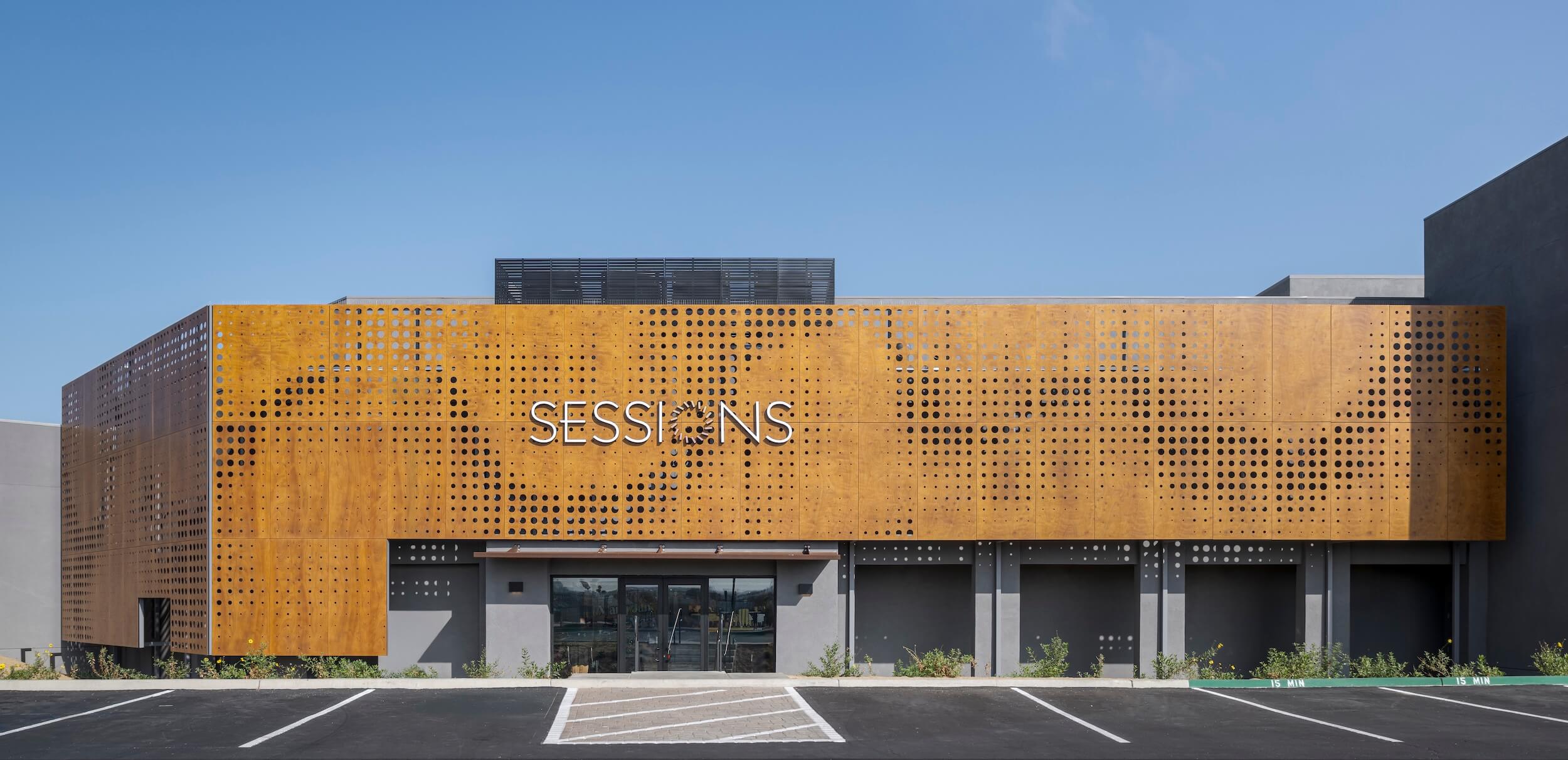
Visible envelope with recycled content: aesthetics, aging, and performance
The most relevant question for the architect is not whether recycled content is desirable in the abstract, but how the material behaves once the building is complete. In the “visible” envelope, the criterion cannot stop at recycled-content percentages, because variables the user perceives immediately—color, texture, gloss, flatness, joints—come into play, as well as others that only appear over time—warping, fading, staining, oxidation, efflorescence, micro-cracking, or loss of finish. That’s why, rather than talking about “recycled material” as a category, it makes more sense to think in terms of finish families and their real in-service behavior, where input traceability and manufacturing control matter as much as detailing design.
When recycled content reaches the aesthetic layer, the key question is visual stability. Selection should rely less on the “claim” and more on testing, warranties, built references, and maintenance protocols.
In addition, for exposed envelopes, recycled content cannot be evaluated in isolation from the construction system and applicable regulations, because real performance is determined by the assembly as a whole. Outdoors, the fire performance of the façade system can be decisive, and a “good” panel on its own does not solve a poorly designed cavity or a junction that encourages water ingress.
Indoors, the focus shifts toward emissions (VOCs), impact resistance, hygiene, maintenance, and repairability—especially in high-use settings. And this is where the typical greenwashing risk appears: claddings that declare recycled content but provide no traceability, have no EPD, or do not explain whether the recycled content is pre-consumer or post-consumer—or that compensate with marketing what they lose in durability and replacement cycles.
In visible finishes, sustainability is not only “what it’s made of,” but how long it looks good, how many interventions it requires, and how easy it is to disassemble, repair, or replace it without redoing half a façade or an entire interior.
Cost and feasibility: it’s not “more expensive” or “cheaper,” it’s a different economics
When the doubt revolves around cost, it helps to abandon both the cliché that sustainability always costs more and the opposite message that recycled content always lowers costs. The economics of recycled content depend on industrial scale, energy prices, waste availability, logistics, and the maturity of the local market. In materials where recycling is well established, the premium can be zero—or even negative. In innovative solutions or smaller-scale production, there may be a premium, especially if the manufacturer assumes traceability, sorting, and additional testing.
However, the real economic analysis for a specifying architect should rarely end at the unit price. More and more jurisdictions incorporate incentives, requirements, or price signals linked to waste, circularity, or carbon, which pushes teams to calculate value in terms of whole-life building cost, regulatory risk, and alignment with the client’s or certification goals.
Aesthetics and performance: from an “eco brand” to a design attribute (visual and mechanical)
Aesthetics is, paradoxically, more of a cultural barrier than a technical one—but the qualitative leap happens when we understand that recycled content doesn’t only “look” a certain way: it also works. The prejudice persists that recycled materials “show,” and therefore limit architectural language, as if sustainability came with an obligatory visual palette. Yet recycled content can be invisible when neutrality is the aim, or it can become part of the material narrative if the project embraces it.
At the same time, it can redefine performance in ways that affect detailing, assembly, and durability decisions. The issue, therefore, is not whether recycled content “affects” aesthetics, but whether the design team integrates it as an integral design attribute—image plus performance— or treats it as a technical requirement that must remain outside the project’s discourse.
Certifications, Cradle to Cradle, recycled content certification, and EPDs: what they validate, what they compare, and what they don’t guarantee
Environmental certifications have helped professionalize the debate, although they have also introduced a tendency to “design for points” rather than design to reduce impact. Systems such as LEED, BREEAM, or DGNB (with regional variations) often recognize recycled content, but increasingly do so more sophisticatedly, requiring robust documentation and, in many cases, integrating it into building LCA strategies. Within this framework, the EPD becomes a central instrument: it does not automatically make a material “good,” but it makes impacts transparent under predefined rules.
However, when the focus is circularity and the “quality” of recycling, complementary tools come into play. Cradle to Cradle (C2C) evaluates the product from a broader logic of material health, circularity (reuse/recovery), energy, water, and social responsibility—providing a “design for cycles” reading that an EPD alone does not cover.
Meanwhile, a Recycled Content Certification (a specific recycled-content certification) verifies and traces the percentage and origin of the declared recycled content, reinforcing the credibility of the data when the market demands it.
Good specification emerges when EPD + C2C + recycled-content certification are used as decision tools rather than “virtue badges,” and when recycled content is weighed against other relevant indicators such as durability, maintenance, indoor emissions, and real circularity potential.
Where recycled content makes sense (and where caution is advisable)
The practical question ends up being: where does it make sense to use recycled content, and where is caution advisable? Generally, recycled content tends to deliver more when applied to high-volume or high-mass building elements, because the potential reduction in extraction and embodied carbon can be significant. It also works especially well when the recycling loop is industrially mature, when there is a traceable supply chain, and when the product maintains stable quality standards.
By contrast, caution is warranted when recycled content introduces variability that is difficult to control, when it compromises safety or durability, when it forces fragile construction details, or when the resulting system makes maintenance, repair, or disassembly harder. The mature question is not “can I use recycled content?” but “does it deliver a net environmental and technical benefit here, without creating new hidden risks?”
Compatibility with traditional systems: the opportunity to move forward without “reinventing everything”
Compatibility with traditional construction systems is, fortunately, one of the best pieces of news right now. A growing share of recycled-content materials can be integrated without changing site processes, without requiring specialized labor, and without drastically altering common detailing. This reduces implementation friction and allows material sustainability to advance without turning every project into an experimental prototype.
Still, compatibility should not be assumed; it must be verified through specifications, testing, and—where appropriate—coordination with site management, industrial partners, and suppliers from early stages.
A professional responsibility that is no longer optional
Everything suggests that recycled content will stop being a differentiating attribute and become a basic expectation, driven by both regulation and the market. Pressure to reduce embodied carbon, the consolidation of circular-economy frameworks, and the advancement of building-scale LCA tools are pushing the sector toward more quantifiable decisions. In this scenario, the architect cannot limit themselves to specifying by habit or by catalogue. Their professional responsibility expands: they must understand the impact of the materials they choose, be able to read environmental documentation without resorting to shortcuts, and apply judgment that balances performance, cost, aesthetics, durability, and footprint.
Recycled content is neither a universal solution nor a moral wildcard, but it is a powerful tool when used rigorously. Adopting it with technical criteria can reduce impacts today, improve a project’s resilience to regulatory changes, and raise the quality of the conversation between design and industry. And, above all, it can return to architecture a function it has always had: making material decisions with awareness of its time—knowing that every choice builds not only a building, but also the kind of economy and territory in which that building will be possible.
Recycled content in our products: a key circularity strategy at Parklex Prodema
At Parklex Prodema, incorporating recycled content into the manufacture of our products is a strategic line within our policy for the sustainable management of natural resources, especially in relation to forest resources. Reusing materials that have already been processed and used allows us to reduce pressure on ecosystems, limit deforestation, and decrease the need to produce new raw material—resulting in savings in energy, water, and emissions associated with extraction and manufacturing processes.
Currently, our compact products incorporate 10% recycled content by total weight, the result of a systematic review of materials and optimization of formulations: we have reached that percentage, among other measures, by using 25% recycled paper in the panel core and replacing traditional components with recycled film on the back face. In addition, we give a second life to the resin used in some processes by recycling it and reusing a percentage of it in other production processes, driving material circularity.
Looking ahead to 2026, one of our main objectives is to progressively increase the percentage of recycled material in the manufacture of these products, exploring new sources of secondary materials compatible with our processes, certifications, and quality standards—because we believe the future of materials lies not only in designing for use, but also for reuse.