The installation process is a critical factor in the long-term performance of natural wood flooring. Beyond aesthetics, a technically correct execution ensures dimensional stability, durability, and functionality. This guide covers the main installation systems and technical recommendations for their proper implementation in architectural projects.
Pre-Installation Substrate Assessment
A thorough substrate analysis is the essential first step for any installation:
- Leveling: Maximum recommended tolerance of ±3 mm over a 2 m straightedge for floating systems, stricter (±2 mm) for glued systems.
- Residual Moisture: Maximum values of 2.5% for cementitious substrates and 0.5% for anhydrite, measured with a carbide hygrometer.
- Surface Cohesion: Minimum tensile strength of 1.0 N/mm² for direct glued systems.
Addressing deficiencies at this stage, though initially costly, is always more economical than dealing with issues arising from inadequate substrates later.
Installation Systems: Selection Based on Project Needs
The main installation systems have distinct characteristics and should be selected based on the specific project:
- Floating System: Planks rest on an acoustic underlay, joined by tongue-and-groove with adhesive in the joints. Not fixed to the substrate, allowing natural micro-movements of the wood.
- Glued System: Direct adhesion to the substrate using elastic adhesives applied in beads or full-surface coverage. Maximizes acoustic and thermal contact.
- Nailed System: Mechanical fastening to battens, recommended for unstable substrates or those with high residual moisture.
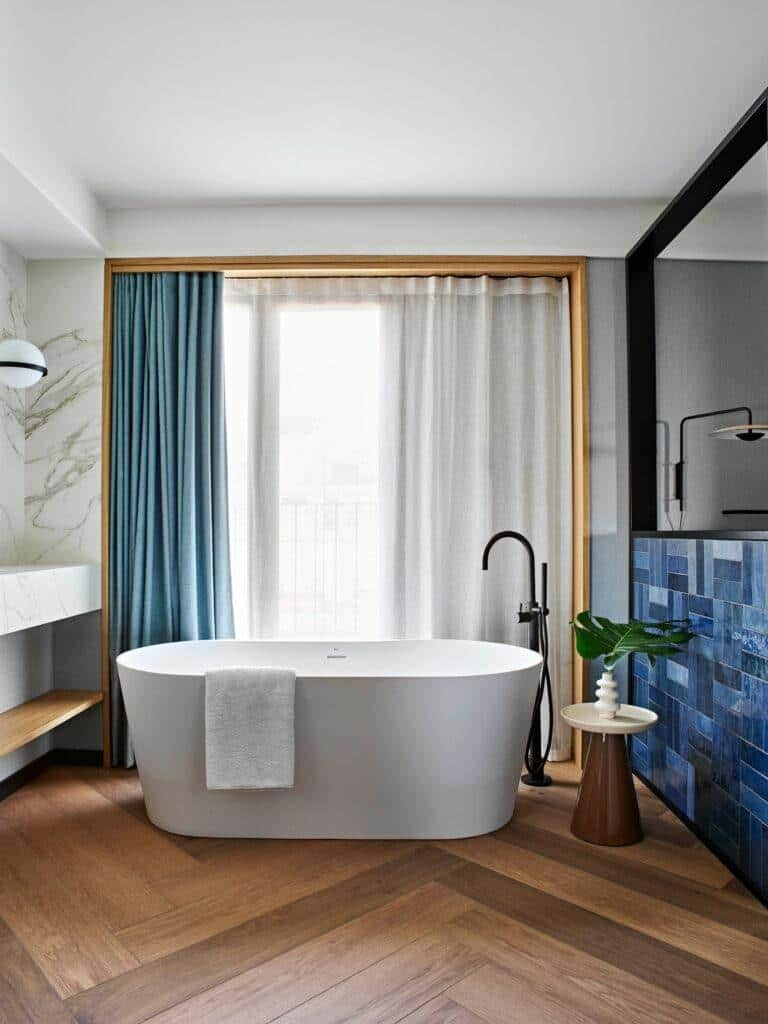
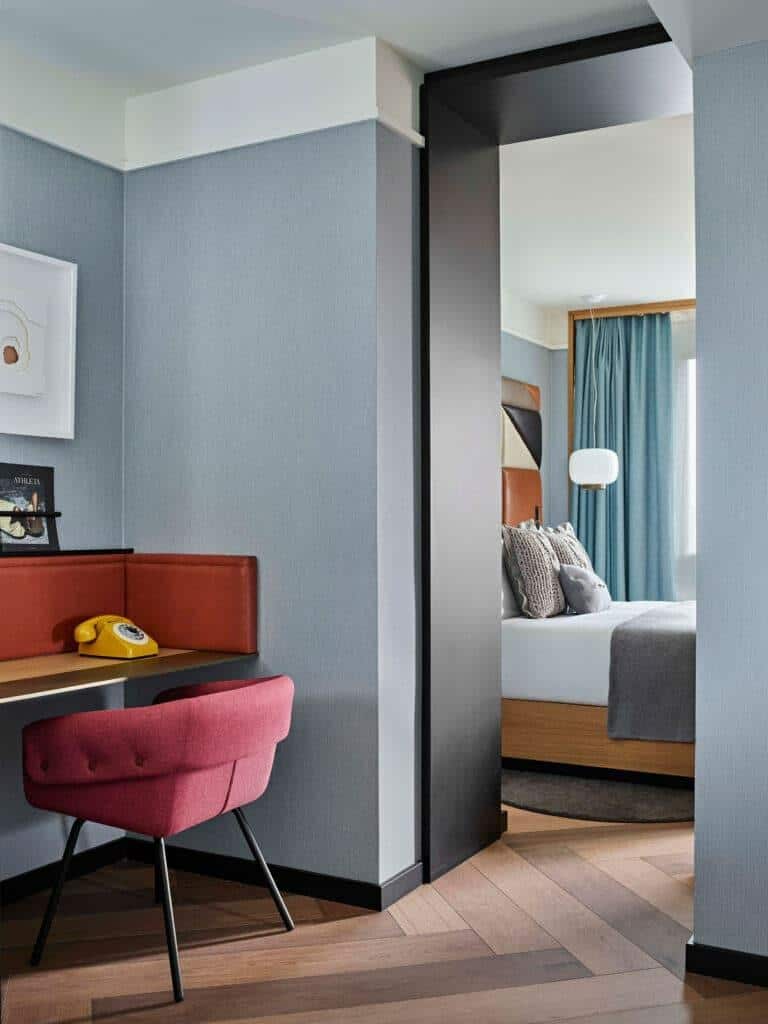
For NATURFLOOR-W flooring, the floating system with acoustic underlay and glued tongue-and-groove joints combines structural stability and acoustic comfort, as demonstrated in installations at the Kimpton Vividora Hotel by El Equipo Creativo.
Acclimatization: A Critical, Often Underestimated Phase
The hygrothermal adaptation of the material to the installation environment is crucial:
- Minimum Duration: 72 hours per general recommendations, extendable to 5 days per NWFA guidelines for demanding projects.
- Room Conditions: Temperature of 15-27°C and relative humidity of 40-65%, ideally stabilized to the building’s normal usage values.
- Acclimatization Setup: Open packages, laid flat, centered in the room, avoiding contact with walls or structural elements.
Skipping this phase significantly increases the risk of deformations, gaps between planks, or warping post-installation.
Techniques for Different Patterns
Installation patterns require specific technical considerations:
- Straight Pattern (1/4 or 1/2): Establish a master line perpendicular to the room’s longest side, preferably aligned with natural light entry.
- Herringbone Pattern: Requires specific planks (188×1200 mm for NATURFLOOR-W) with precise machining. Accurate symmetry axes are critical.
- 45° Installation: More complex cutting and higher material waste (15-20% additional) but reduces visual perception of potential movements.
A preliminary “dry” layout allows verification of the aesthetic result and adjustments before final fastening, especially important for complex patterns.
Perimeter and Expansion Joints
Anticipating wood movement through proper joints ensures system stability:
- Perimeter Joint: Minimum 8-10 mm around the entire perimeter, including elements like columns or pipes.
- Expansion Joints: Recommended for areas larger than 10×8 m or continuous lengths exceeding 12 m.
- Transition Treatments: Specific channels for changes in flooring or transitions between rooms.
These technical joints can be concealed with baseboards or channels but must never be eliminated or filled with rigid materials that restrict natural movement.
Recommendations for Radiant Heating
Installation over radiant heating requires specific protocols:
- Pre-Activation: Complete heating and cooling cycle before installation to eliminate residual moisture.
- System Off During Installation: Maintain a moderate substrate temperature (15-18°C).
- Gradual Post-Installation Increase: Maximum 5°C daily increase until reaching operational temperature.
- Maximum Surface Temperature: Limited to 29°C to preserve wood stability.
Adhering to this protocol minimizes the risk of excessive shrinkage or deformations during initial heating cycles.
Final Inspection and Occupancy
Post-installation inspection should verify critical points:
- Final Flatness: No protrusions between planks (maximum tolerance ±0.2 mm).
- Adhesion Stability: Complete bonding to the substrate in glued systems.
- Sound performance: No noises during foot traffic that indicate installation deficiencies.
Immediate occupancy is possible with NATURFLOOR-W flooring, as it requires no post-installation varnishing or treatments, a significant advantage for projects with tight timelines.
Need specific technical advice for your project? Contact our team with no obligation to address technical questions, analyze specific requirements, or develop customized solutions.